
 By
By 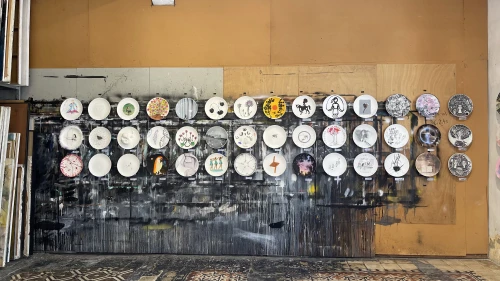
 A decade ago, 30-year-old Avi Miller would never have imagined standing in a Tel Aviv studio, looking at his artwork as part of a national exhibition.
As a teenager growing up in a Haredi family in Jerusalem, he made the difficult decision to leave full-time Torah study in a yeshiva and enlist in the IDF Paratroopers Brigade — a choice that isolated him from his family and, for a time, left him entirely alone. “After eight months, my commander realized that I simply wasn’t going home when everyone else was, and he applied for me to become a lone soldier,” he said.
Years later, standing among nearly 200 artists contributing to the “A Plate of Hope and Color” exhibition, Miller’s story has come full circle. The exhibition opened at the Uri Lifshitz Studio in Tel Aviv on May 1, 2026.
The concept is simple but deeply symbolic. A plate evokes the idea of home — the family meal, the Shabbat table, the warm kitchen that lone soldiers so often go without. Some 230 original artworks on white ceramic plates by leading Israeli artists benefit the Lone Soldier Center in Memory of Michael Levin, which supports some 5,000 soldiers at any given time.
The participating artists span Israel’s cultural landscape, including painters, sculptors, graphic artists and musicians — Jewish, Druze and Arab alike.
“This exhibition is not only about presenting art, but about showing art’s ability to rally around a greater cause and offer hope,” said curator Ronit Reik.
Ari Gottesman, a former lone soldier from the United States, added: “Seeing the artists and creative people in Israel standing behind us lone soldiers doesn’t only mean something to us on a personal level of making us feel less alone. It also provides powerful, authentic tools that we can use to challenge the false narrative being told about us back home.”





Comments