
 By
By 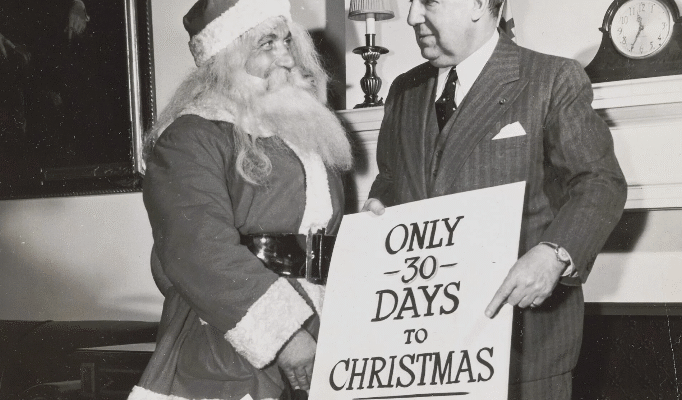
 By Menachem Wecker, JNS.org
The U.S. Postal Service has a term for when the independent federal agency cannot sort or deliver a piece of mail due to an incorrect, illegible or insufficient address: a “nixie.” The same term could apply to Albert Goldman, the Jewish New York postmaster in the 1930s and 1940s, who in many ways foreshadowed social-media “influencers” of today and, in other ways, particularly his personal faith and motivations, proved to be ANK, “address not known.”
The day after Goldman died on May 5, 1967, The New York Times reminded readers that it called the late postmaster “most friendly, helpful and accommodating” when he retired in 1952, after more than 25 years in public office. “No worthy cause in this city has ever had to ring twice to enlist the enthusiastic support of Albert Goldman,” it added.
The Times recorded that Goldman, a “baldish, stout man, talkative, cheerful and energetic” who died at 84 of a stroke after a two-month illness, was most proud of supervising “4,000 Army and Navy postal units at home and abroad in World War II.” That corresponded with “the largest wartime mail volume handled anywhere” and earned him a Medal of Merit, the Times said.
The only hint the newspaper gave of the postmaster’s faith was noting that he was a founder of Yeshiva University’s Albert Einstein Medical College—now distinct from the university—and director of the Hebrew Home for the Aged. It also neglected to mention something upon which it had reported extensively: his role in expanding the postal service’s “Operation Santa” and shaping what remains a lively program nearly 100 years later.
As the Times put it in December 1947, Goldman was the “father of the Santa Claus fund.” TIME recorded in 1941 that Goldman was “official opener of letters-to-Santa Claus.” (One letter Goldman read that year, per the magazine, said: “You better bring all this stuff, or I’ll beat you to a pulp.”)
Jews penned many of the holiday’s central songs, including Irving Berlin’s “White Christmas” and Mel Tormé’s “Chestnuts Roasting on an Open Fire,” and Morris Propp, founder of M. Propp Company, was one of the first to sell Christmas lights widely. Goldman, who often spoke at churches and interfaith events, joins that tradition of Jews who have made their mark on the holiday.
But after poring over more than 500 news stories, photo captions and advertisements in secular publications and in Yiddish and English Jewish ones to try to understand Goldman, his work and his Jewish identity, and after meeting for about an hour and a half with historians at the U.S. Postal Service’s sprawling headquarters in L’Enfant Plaza in Washington and thumbing through hundreds of photographs and documents from the USPS archives about Goldman, this author came away with the distinct impression that this was a very public man, who remained fiercely private.
Although I followed a paper trail of hundreds of instances in which Goldman spoke at official New York and Jewish events, on the radio and to newspaper reporters, and a larger number of times he arranged to have himself photographed with celebrities and others, who Goldman was as a man—what he believed, what he felt deep down, how he grew up—appears to have been, to use a phrase, lost in the mail.
It took hours to establish, for example, that the son of two Russian immigrants who came to America as adults appeared to understand Yiddish.
I spoke at length at USPS headquarters with June Brandt, senior research analyst in postal history, and Stephen Kochersperger, USPS historian.
Kochersperger said that Goldman’s public role “in a post office of that size would have probably been as much a part of his job as actually running the post office.”
“He would have had underlings to do the day-to-day post office operations,” he said. “He was supposed to be the public face of the post office.”
The historian said that Goldman, who was acting postmaster starting on Sept. 1, 1934, and postmaster from Jan. 16, 1935, until his retirement in 1952, “knew how to use the media.”
“I don’t know if you ever saw the famous movie ‘Miracle on 34th Street.’ I’m certain that that would not have happened but for Albert Goldman—the fact that the Postal Service was incorporated into that film to such a large extent,” he said.
I asked if Goldman’s PR acumen might have helped him land the job in the first place. Kochersperger said he wasn’t sure, but even if it did, “he took it to a whole other level.”
“Look how the media changed over that period of time. Radio was pretty young. There was no television. Movies were the thing, and he embraced it,” he said.
Kochersperger said that Goldman had enormous mailbox-shaped temporary postal stations set up in busy places around the city. The stations, which might be 20 feet tall, had clerks inside who sold stamps, mailed packages and did “whatever you needed to do at the post office.”
“I’m sure that was his invention,” he said of Goldman.
Operation Santa
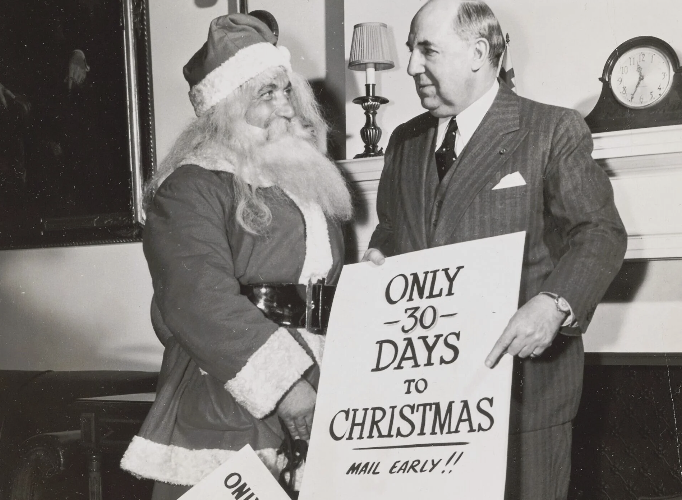
There had been a U.S. Postal Service program since 1912, when people could respond to letters addressed to Santa. Goldman expanded the program to include charitable organizations and corporations, which he encouraged to provide written responses and small toys to needy children.
There are dozens of photos of Goldman posing with people dressed as Santa. “Santa letters were his big thing,” Brandt said.
To read more, the full article can be found at https://www.jns.org/never-a-photo-op-he-didnt-like-jewish-ny-postmaster-grew-shaped-usps-letters-to-santa-program-in-1930s-40s/







Comments