
 By
By 
 By Deborah Fripp
In Arkansas, where Holocaust survivors are rare, eight young adults have become keepers and tellers of survivors’ stories.
“I promise to keep your memory and tell your story.”
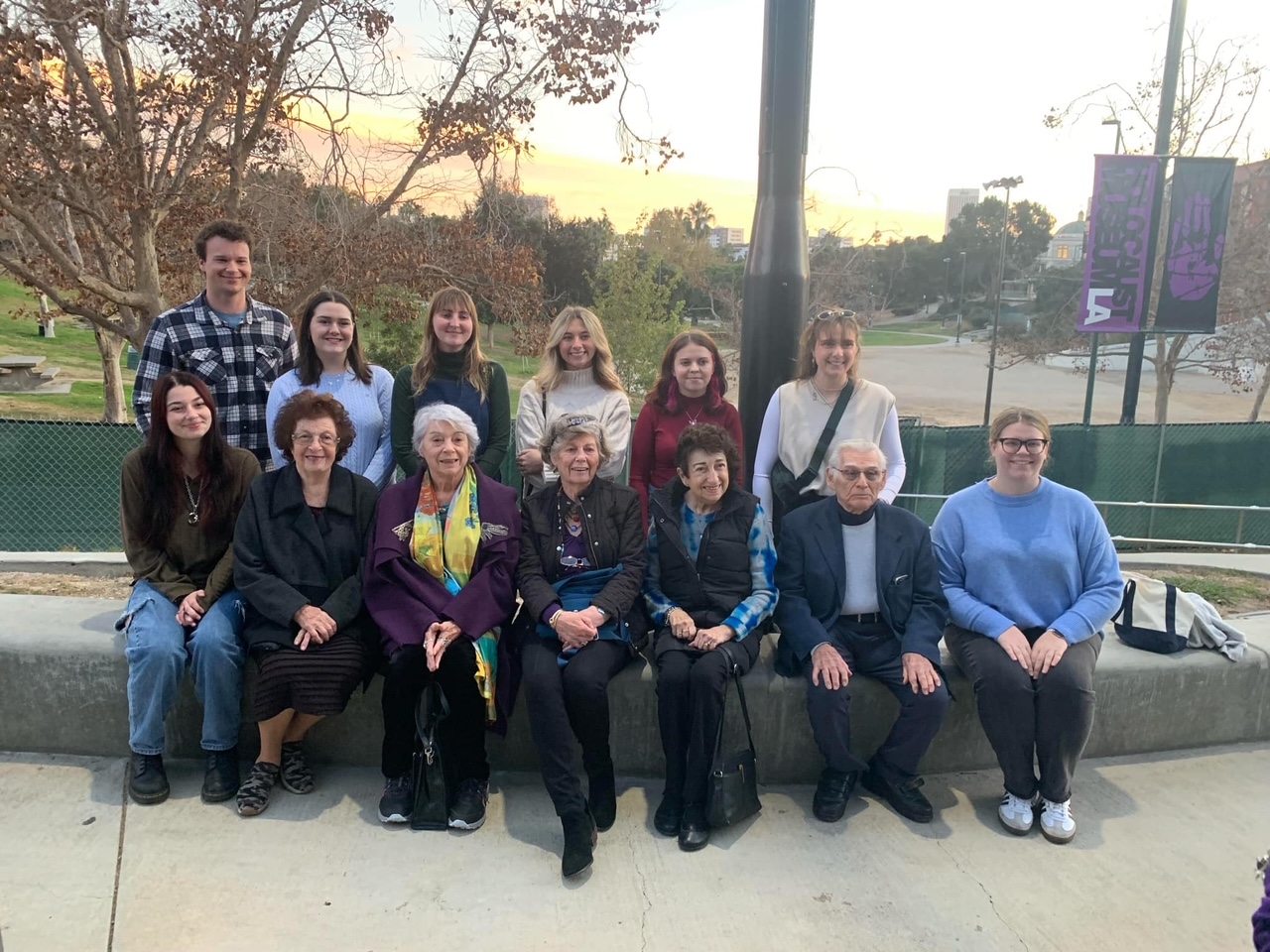
One by one, eight storytellers stand in front of a Holocaust survivor in the library of Holocaust Museum LA in Los Angeles, CA and make this promise. These young adults, ranging in age from 19 to 22, have spent the six weeks getting to know the survivors and learning to tell their stories—becoming keepers of their memories. The survivors have just heard their stories for the first time.
The storytellers might seem an unlikely group to be learning to tell Holocaust stories. They are students from the University of Arkansas in Fayetteville and the University of Central Arkansas in Little Rock. None are Jewish, and only one has a background in Holocaust history. Nonetheless, when the opportunity arose, they embraced it, understanding they were making a life-long commitment.
“Being a part of [this] program changed my life,” says Riley Farco, who learned to tell the story of Holocaust survivor Lya Frank. “Sharing Lya’s story is such a privilege and an honor, and I could not be more thankful to be able to do so. Being a voice for my dear friend’s memory is something I will cherish forever. Every survivor’s story deserves to be told, and [this program] gives life to this goal.”
Who Will Tell My Story?
The program is called Lesaper: From Survivor Memory to Living Teller. Lesaper means “to tell” in Hebrew. It is a collaboration between Holocaust Museum LA (HMLA) and Teach the Shoah (TTS), an online nonprofit that specializes in training people to tell testimony-based stories of the Holocaust.
Lesaper is the brainchild of TTS’s Executive Director Dr. Deborah Fripp and Director of Holocaust Scholarship Lynne Feldman. The program was born after they heard a talk by a representative from the Claims Conference, the organization that distributes reparation money from the German government to Holocaust survivors.
“Ten years ago, survivors asked us: How can I get home healthcare?” he said. “Now they also ask us: Who will tell my story?”
“When we heard that, we realized we had an answer,” Fripp says. “The aim of Lesaper is to create direct connections between the next generation of storytellers and living survivors. It’s a race against time. Eighty years after the end of the Holocaust, few survivors are left to even ask the question.”
They partnered with HMLA Education Project Manager Fanny Wolfowitz and docent Zuzana Landres, who is also a TTS storyteller, to gather a group of interested survivors. Most of the participating survivors are volunteers at HMLA.
“When we were approached, we jumped at the opportunity to say yes,” Wolfowitz says, “because we found a shared commitment to ensuring that the history of the Holocaust and its enduring lessons resonate across generations.”
Keepers of Memory
When a TTS storyteller connected them to Emily Hand, a graduate student in Holocaust history at the University of Arkansas, Fripp and Feldman recognized they had an unusual opportunity. They had the chance to create a cohort of storytellers from Arkansas, a place where few survivors are left. Not only could they pass the survivors’ memories to a new generation of tellers, but they could also bring those memories to a place where few people have the chance to hear Holocaust stories from a living speaker.
Hand presented the idea to classes at two nearby universities. Eight students, six undergraduates and two graduate students, Hand included, were accepted into the program. They signed an agreement promising to tell the stories they were about to learn for as long as they were able.
The students were each matched with a single survivor. They met online twice a week for five weeks. Under the guidance of instructors trained by the Shoah Foundation in interviewing survivors, the students conducted three interviews with their matched survivor, focusing on the survivor’s pre-war, wartime, and post-war experiences respectively. During this period, the students began to develop deep relationships with the survivors.
At the same time, the students worked with TTS storytelling instructors. They learned to understand the Jewish and historical contexts of what they were hearing and to retell those memories in their own words.
At the end of the online training, the students and instructors gathered in Los Angeles for an intensive week-long “bootcamp” to complete the stories and to meet the survivors in person. Meeting in person cemented the close personal ties between the survivors and the students. For the students, telling the survivor’s story became more than a contract; it became a commitment.
Share Our Story
Before they returned home, the students presented their stories to the survivors and their community. Standing in front of the survivors, they promised to carry on each survivor’s memory and to continue to tell their stories.
The survivors were overcome. After listening to storyteller Riley Farco tell her story, survivor Lya Frank said, “It was totally different from how I present my own story. Very, very insightful. I’m almost emotional, and I’m not an emotional person.”
“This is all we ask,” Lya told Riley. “Share, share our story.”
In the months since returning home, these eight young storytellers have brought the survivors’ stories to hundreds of people across Arkansas. Audiences of all backgrounds, people who might otherwise never have had the chance to hear such a story in person, have been moved by these storytellers and the important stories they tell.
The Lesaper project is ongoing: right now, a second cohort storytellers is learning to tell the stories of a second group of Holocaust survivors. You can hear their stories on Sunday, December 21at 2 pm PST at the Museum of Tolerance in Los Angeles.
Register to attend in person: https://theirstories.org/21Dec2025. Join the livestream (no registration necessary) at https://theirstories.org/21Dec2025Stream.




Comments